
About VitaComm Education
STEAM Series – Part 3: What Makes a STEAM Experience Meaningful?

STEAM Series – Part 3: What Makes a STEAM Experience Meaningful?
Welcome back to our STEAM Series. So far, we’ve explored what STEAM really is and why it often feels so different from more traditional approaches to learning. We’ve reflected on curiosity, inquiry and the importance of allowing children to investigate rather than simply receive information. Naturally, this leads to another question: What actually makes a STEAM experience meaningful?
It’s tempting to think that a successful STEAM activity is one where children are busy, engaged and having fun. While those things certainly matter, they are only part of the picture. An activity can be exciting without being particularly meaningful, just as a quieter activity can lead to profound learning. Over the years, I have come to realise that the real question isn’t simply whether children are active. It’s whether the experience invites them to think deeply, feel genuinely, connect with others and become active participants in their own learning.
That shift in perspective changes everything.
As I worked on the SPIRIT STEAM Toolbox, I found myself returning to the same questions again and again whenever I designed or reviewed an activity. Not because they formed a checklist, but because they became a kind of compass. They reminded me that meaningful learning is rarely defined by what the teacher does. It is shaped by what the child experiences.
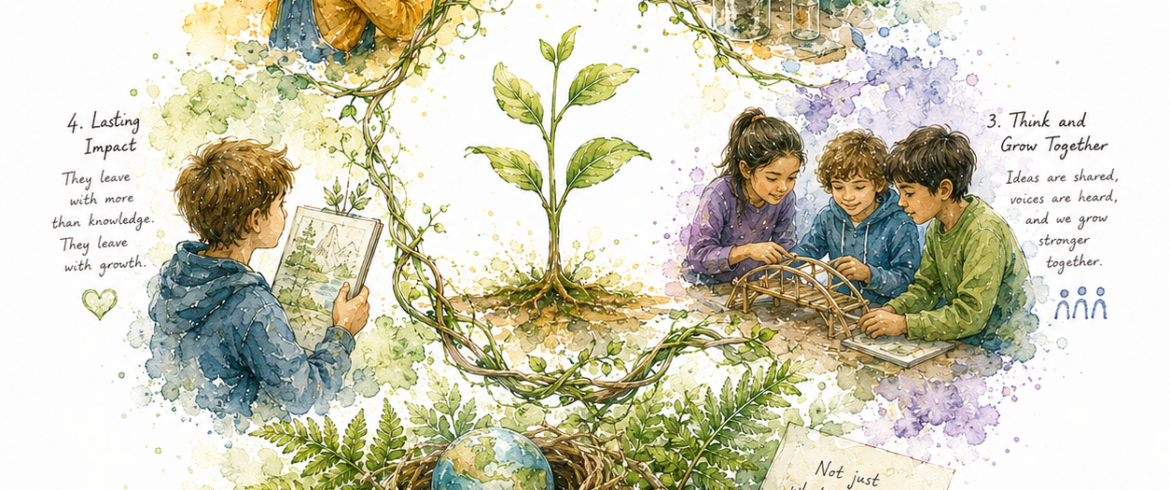
The first question is simple: Does this activity begin with a meaningful question, challenge or phenomenon? Children are naturally curious, but curiosity needs something to hold onto. Whether it is discovering why some bridges are stronger than others, investigating how plants respond to different conditions or finding ways to reduce waste in their school, meaningful learning begins when children encounter something that genuinely invites them to wonder. It is that feeling of “I want to find out” that opens the door to deeper learning.
The second question follows naturally: Will children investigate, or will they simply follow instructions? There is an important difference between completing a task and exploring an idea. In authentic STEAM learning, children are encouraged to observe carefully, ask questions, test possibilities, gather evidence and revise their thinking as new discoveries emerge. They experience uncertainty, excitement, frustration and satisfaction—all emotions that become part of the learning journey. The learning lives within the process, not only the final product.
A third question asks us to look beyond individual achievement: Does this experience encourage children to think and grow together? Some of the richest moments in a STEAM classroom happen through conversation. Ideas are challenged respectfully. Different perspectives emerge. One child’s observation sparks another child’s solution. Children learn to listen, explain, negotiate, encourage one another and celebrate successes together. Collaboration becomes much more than dividing up the work—it becomes a way of building understanding and relationships at the same time.
Finally, perhaps the most important question of all is this: What will children leave with once the activity is over? Of course, they may leave with new scientific knowledge, stronger mathematical understanding or a finished design they are proud of. But my hope is that they also leave with something less visible. Greater confidence to ask questions. The resilience to persist when something doesn’t work. The empathy to listen to another perspective. The flexibility to change direction. The curiosity to continue exploring. A stronger belief that learning is something they actively shape rather than something that simply happens to them.
This is one of the reasons I have come to appreciate STEAM so deeply. It reminds us that meaningful learning is never only about acquiring knowledge. It is about creating experiences that help children make sense of the world while also discovering something about themselves. They are developing understanding, certainly—but they are also developing confidence, relationships, values and a sense of possibility. The activity is simply the vehicle. The real destination is the child’s growth—not only in what they know, but in how they think, how they feel, how they relate to others and how they begin to understand both themselves and the world around them.
In our next article, we’ll explore something that sits at the very heart of the SPIRIT project itself: how meaningful STEAM experiences naturally create opportunities for the development of the ten transversal skills. Because one of the most remarkable things about authentic learning is that it rarely teaches just one thing at a time.
